Munisense | Measuring Traffic Noise | Continuous Monitoring of…

Measuring Traffic Noise

Measuring traffic noise

Traffic noise is one of the largest sources of noise pollution in the Netherlands. Municipalities, provinces, and road authorities are therefore increasingly looking for ways to objectively map traffic noise and effectively reduce it. But without reliable measurement data, it remains difficult to take the right measures.

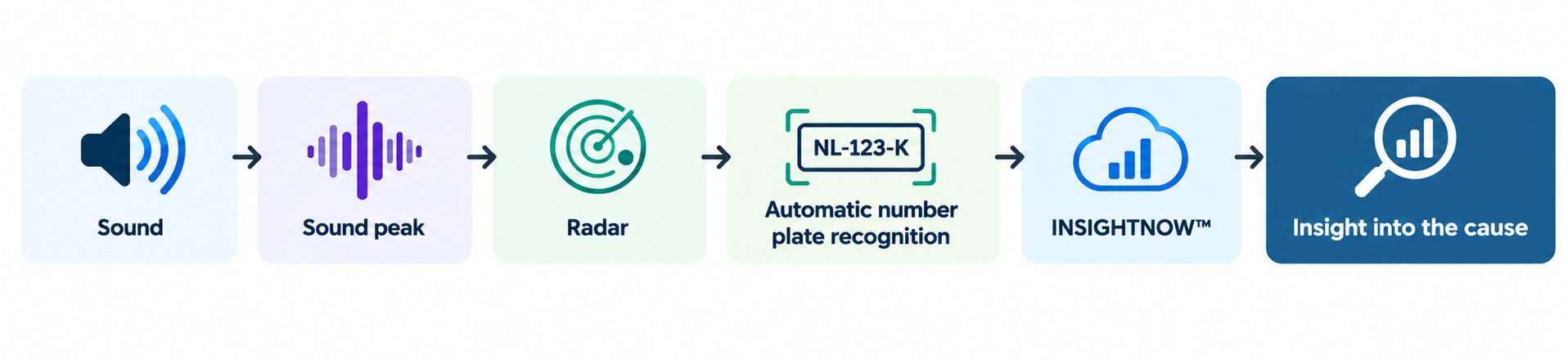
With Munisense’s noise monitoring systems, you can measure traffic noise continuously and fully automatically. Thanks to smart sensors and the powerful INSIGHTNOW™ platform, you gain insight not only into noise levels but also into patterns, noise peaks, and the locations where the most noise pollution occurs. By combining noise measurements with technologies such as radar, automatic number plate recognition (ANPR), and smart correlation, you can also identify which vehicles are responsible for the highest noise levels.

This provides you with objective data to analyze traffic-related noise pollution, support policy decisions, and demonstrate the effectiveness of those measures.
Why measure traffic noise?

Traffic noise is one of the largest sources of noise pollution in the living environment. Residents experience nuisance from cars, motorcycles, freight traffic, or accelerating vehicles, while policymakers need objective data to assess complaints and justify measures.

One-time measurements provide only a snapshot. Continuous monitoring reveals where, when, and why traffic noise occurs. This brings to light patterns that often remain hidden with isolated measurements.

✔️ Objective insight into traffic noise

✔️ Noise peaks and patterns made visible

✔️ Demonstrable effect of measures

✔️ Support for policy and enforcement

Continuous monitoring instead of snapshots

Noise is constantly changing. Traffic volume varies by hour, day, and season, and weather conditions can also affect measured noise levels.

Continuous measurement provides insight into:

  • daily and weekly patterns;
  • peak traffic during rush hour;
  • structural or incidental noise pollution;
  • trends over longer periods;
  • the effect of traffic measures.

With continuous monitoring, you always have access to both current and historical data, ensuring that decisions are based on reliable data rather than isolated incidents. This also allows you to objectively track the impact of new traffic measures.

From noise level to the cause of the disturbance

A high noise level does not automatically reveal what is causing the disturbance. Is it heavy traffic? A single motorcycle? A truck? Or perhaps traffic accelerating at an intersection?

Combining noise measurements with additional information provides much greater insight. By correlating noise data with radar, automatic number plate recognition (ANPR), and other data sources, we gain a much deeper understanding of the causes of traffic noise. This reveals which vehicles are responsible for noise spikes and where targeted measures will be most effective.

It is precisely this combination of sensor data that makes the difference between merely measuring and truly understanding.

From noise level to the cause of the disturbance

Smart technology for better insight

Depending on the application, a measurement setup can be expanded with additional technologies, such as:

  • radar for recording vehicle passages and speed;
  • license plate recognition (ANPR);
  • automatic detection of noise spikes;
  • correlation between different data sources;
  • online dashboards for real-time and historical analyses.

All data is clearly consolidated in the INSIGHTNOW™ platform, giving users immediate access to both current and historical insights.

From insight to effective measures

Objective measurement data forms the basis for effective traffic policy. It helps answer questions such as:

  • Where does the most noise pollution occur?
  • Which vehicles cause the highest noise peaks?
  • At what times does the most noise occur?
  • Do traffic measures actually have an effect?
  • Is additional enforcement or behavioral intervention desirable?

Thus, continuous monitoring not only provides the basis for insight but also for better-informed decisions.

Nudging and behavioral intervention

Not every type of traffic noise requires enforcement. In many situations, behavioral intervention alone can lead to a noticeable reduction in noise pollution.

By providing drivers with real-time feedback via an awareness sign, they become more aware of their driving behavior. 

In combination with continuous noise measurements, it is then possible to objectively determine whether this form of nudging actually leads to less traffic noise. Road authorities can also objectively assess whether behavioral intervention is more effective than additional enforcement.

Case Study: N525 – From Noise to License Plate

N525 2026

On the N525, research is underway to determine how traffic noise can not only be measured but also better understood and influenced. The existing pilot program for detecting loud vehicles has therefore been extended and expanded to include radar, automatic number plate recognition (ANPR), and an online dashboard.

Combining noise measurements with vehicle data provides insight into which vehicles are responsible for noise spikes, when they occur, and what the actual noise impact is. The dashboard clearly consolidates all the data and enables analyses over longer periods.

The measurement site is located on the N525, immediately after the A1 overpass heading toward Hilversum. The radar and ANPR camera are directed exclusively at the roadway, ensuring that the measurements remain reliable and targeted.

This case study demonstrates how continuous monitoring and smart correlation of various data sources lead to objective insights. This creates a solid foundation for better understanding traffic-related nuisances, demonstrating the effectiveness of measures, and making targeted adjustments where necessary.

Reliable data as the foundation for better decisions

Measuring is not the goal. Reliable data that enables you to make better decisions is. 

That’s why Munisense combines high-quality sensors with automatic data validation, smart correlation, and the INSIGHTNOW™ platform. 

This way, you don’t just have measurement values—you have reliable information that allows you to analyze traffic congestion, support policy decisions, and demonstrate results.

Curious about how you can continuously monitor traffic noise?

We’d be happy to show you how continuous noise monitoring can contribute to a better understanding of traffic noise and the effectiveness of traffic management measures.

Our contact details

Address

Phone

Let's get in touch

Contact us

Frequently Asked Questions About Measuring Traffic Noise

Traffic noise is the sound caused by road traffic, such as passenger cars, motorcycles, trucks, and buses. Unnecessary honking, rapid acceleration, and vehicles with loud exhausts can also be significant sources of noise pollution. Noise levels are determined by factors such as traffic volume, speed, road surface, vehicle type, and driving behavior. Continuously monitoring traffic noise provides insight into where, when, and why the most disturbance occurs.

The noise level of road traffic varies greatly and depends on the type of vehicle, speed, distance from the road, and the surrounding environment. On busy roads, noise levels often range between 60 and 80 dB(A) at close range to the roadway, while individual vehicles—such as motorcycles, sports cars, trucks, sirens, or a horn—can cause significantly higher noise peaks. Therefore, it is not only the average noise level that is important, but also an understanding of noise peaks and the times at which they occur.

Traffic noise is measured using professional sound level meters that continuously record noise levels. Combining these measurements with smart software provides insight into patterns, noise peaks, and the evolution of traffic noise over time. Continuous monitoring provides a much more reliable picture than a one-time noise measurement.

A one-time noise measurement provides only a snapshot. Continuous monitoring records noise levels day and night, revealing trends, peaks, and chronic noise pollution. This allows for better substantiation and evaluation of mitigation measures.

Whether traffic noise is perceived as a nuisance depends on several factors. Not only does the average noise level play a role, but so do the frequency, the time of day, and the nature of the noise. Recurring noise peaks—caused, for example, by vehicles accelerating rapidly, engines, or unnecessary honking—are often perceived as much more disruptive than a steady flow of traffic. That is why public authorities consider not only average noise levels but also noise peaks and their impact on the living environment.

Not every vehicle contributes equally to traffic noise. In practice, it is often individual vehicles—such as motorcycles, sports cars, or heavy vehicles—that cause the highest noise peaks. By combining noise measurements with radar and license plate recognition, these instances can be identified.

Yes. By correlating noise measurements with radar and ANPR, a much more complete picture of traffic noise emerges. This makes it possible to determine which type of vehicle is responsible for a noise spike and to take targeted measures.

By taking continuous measurements before and after a measure is implemented, changes in noise levels can be objectively determined. Examples include adjustments to road design, speed limits, or nudging with warning signs.

Reducing traffic noise starts with objective insight. Continuous noise measurements reveal where, when, and how noise pollution occurs. Based on this, targeted measures can be taken, such as adjustments to road layout, speed limits, quieter road surfaces, or behavioral nudging. This approach can also shed light on nuisances caused by rapid acceleration, loud vehicles, or unnecessary honking. By continuing to take measurements even after implementation, the effect of measures can be objectively assessed and adjusted if necessary.

  • municipalities;
  • provinces;
  • environmental agencies;
  • engineering firms;
  • road authorities;
  • contractors.

And... we’d be happy to brainstorm with you or prepare a proposal for your traffic project.

Load new page icon